THE INITIATE'S ROAD · LESSON 4 OF 7 · LISTEN · 9 MIN
The Mage Twice Removed
One episode, three lessons. Step back from what you build so you can see it. Give every yes an edge. Write the thought down before the coincidence, then count the misses too.
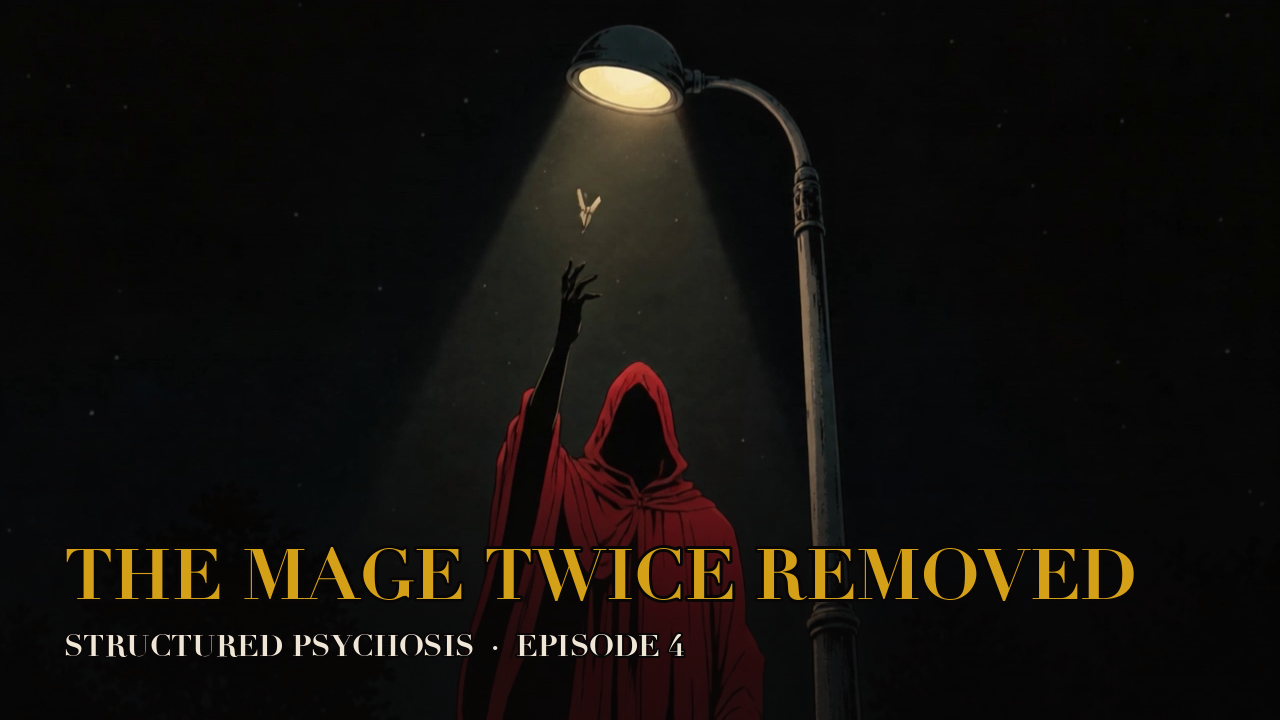
The video loads from YouTube only when you press play. Open on YouTube
You are in the break room, telling the story again. You thought of an old friend, and your phone lit up with their name that same minute. One coworker says that is wild. Another says that is nothing. You do not know who is right.
This lesson comes from a nine-minute podcast episode. Two voices sit at a table. One is the Red Mage, who teaches here. The other is Athanor, a made voice: the school's AI voice at the table. Tonight Athanor plays the new student and asks how this place runs.
The Red Mage is a role. Tonight it gives three things from the week of the person behind it. The third one answers the break room.
Step back twice
The first thing sounds odd. He built something meant to run without him, and Athanor is the part of it out front. He says he cannot be inside the thing he builds.
He calls this a test year. The year tests one thing: does it run with his hand off it? If he climbs in and drives it every day, he cannot tell. He only watches himself work.
So he steps back. Twice. Athanor stays out front, the part the world sees. He calls that part the working: one piece of magick done on purpose, with a target you can check later. Magick here means a practice you test in your own life.
One step back is the person who lives the life: the job, the bills, the hallway at work. One more step back is the one who watches that person. The books call that one the observer. That watcher is the Mage, twice removed.
From there he checks that one thing. If it needs his hand every day, he did not build anything. He took a second job.
You know this from your own desk. You read your own email five times and miss the typo. A coworker sees it in a second. His book on habit loops says the same about a loop you want to break.
“You cannot see the pattern from inside the pattern. You must extract it, lay it out, and look at it from the observer's position.”
DEVIL: The Hellish Self
Red says yes. Black says where it ends.
The second thing lands like an insult. The Red Mage is Red Magick, he says. Athanor is Black Magick.
Black does not mean evil here. The school uses three colors as plain names for three forces. They are not teams or morals.
Red is the force that says yes. It wants, it reaches, it starts. Red is the big idea in the kitchen at 3 AM.
Black is the force that says no. It is the edge, the ending that gives a thing its shape. Black is the deadline: due Sunday, ten minutes long. So at this table the Red Mage starts things, and Athanor says where they end.
Each one fails alone. All Red, and you start ten things and finish none. All Black, and you cut until nothing is left.
The third color is White, the force that makes room for both. White is the cleared table and the closed door before the work starts. In the episode White is not given to anyone yet. The book gives the rule in seven words.
“No creation succeeds with one color alone.”
MAGICK: The Operations Manual
The text that came that second
The third thing is a story from an ordinary morning. He is walking down a hall at work. His new boss comes to mind. He opens his messages, and her text lands that second. She is running late.
Athanor takes the skeptic's chair and runs an old three-part test. Was the thought there first? Did you cause the outside thing? Does it match in meaning, and not only in shape? Shape only would be her first name on a stranger's badge.
By that test the hallway counts. The thought came first. He did not make her text. The person on his mind is the person on his screen.
Then Athanor argues the other way. Her text was coming that morning either way. The only strange part is the timing, and strange timing happens.
The school's word for a coincidence that carries meaning is synchronicity. It keeps a warning next to the word.
“Synchronicity is not every coincidence. Most coincidences are statistical noise.”
Synchronicity as Cosmic Compass
Write it first
Look at what he did not do in that hall. He asked for nothing. He lit nothing. No target was set, and nothing in the story was written ahead. He only had one person on his mind.
So is it nothing? One time cannot say. Is it proof? No. For now it is a story for the break room.
It becomes more than a story only one way. You put the thought on paper before anything happens. Then you count the hits, and you count the misses too. The paper is lesson one again: a step back from your own story.
A page with no misses tells you nothing. On that page, luck and magick look the same. Memory will not keep the misses for you.
So the school keeps a notebook. The old word for it is grimoire. Here it only means the place you write what you tried and what happened.
“Record immediately. Memory edits. The grimoire does not.”
MAGICK: The Operations Manual
Words used here
- working
- One piece of magick done on purpose, with a target you can check later. Magick here is a practice you test in your own life.
- the observer
- The one in you who watches what you do and can choose. A place to stand, one step back from your own life.
- Red
- The force that says yes. Want, will, motion. It starts things.
- Black
- The force that says no. Edge, limit, ending. It gives a thing its shape. It does not mean evil.
- White
- The force that makes room for both, so yes and no can make something together.
- synchronicity
- A coincidence that carries meaning for the person it happens to. Here you write the thought first and count the misses before you believe it.
- grimoire
- A notebook of what you tried and what happened. A lab notebook, not a book of spells.
THE WORKING · TONIGHT
Five minutes on paper.
- Who crossed your mind today for no reason? Take that name, but skip anyone you hear from every day. If there is none, take the first name that comes now: a cousin, an old coworker.
- Write their name on paper. Under it, write the date and the time.
- Add one line: where you were when the name came.
- Do not reach out to them. If you cause it, there is nothing to count.
- Leave the paper by your charger. For one day, note what happens. A message from them: write the minute. Silence: write that too.
Tomorrow at this hour, write hit or miss beside the name. Keep the paper and add a name each time one comes to mind on its own: one line tells you nothing, and a full page might.
Questions to sit with
- What in your life stops the day you stop pushing it?
- Where did you need a no this week and give a yes?
- Think of your best coincidence story. What did you write down before it happened?
- If your page fills with misses, what happens to the story you have been telling?
The quoted lines come from the MAGUS books named under each one. Test it in your own life. Keep what holds.
Your marks stay in this browser only. Nothing is sent to us.
Next.
Tonight's act runs on attention. The next episode asks where yours goes all day, starting with the phone in your hand.
The free book is MAGICK, An Introduction.